
Building Bridges, Changing Lives: Global Mission Ministry Reaches New Communities Across the Caribbean
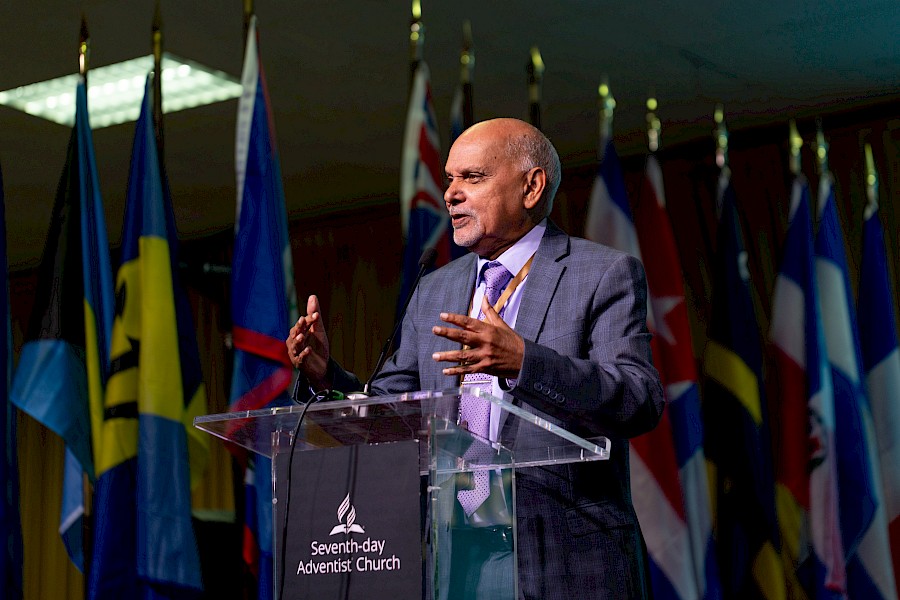
Global Mission and Public Affairs and Religious Liberty Director Dr. Clive Dottin urged delegates to view relationship-building as the foundation of evangelism, highlighting how strategic outreach among diverse communities has opened new doors for the gospel across the Caribbean Union. The report showcased cross-cultural ministry, church planting initiatives, and lives transformed through compassionate service.
Reading time | 3 mins
MARACAS VALLEY, Trinidad — Religious freedom is not merely a legal protection; it is a God-given right that allows faith, conscience, and mission to flourish. That conviction anchored the Public Affairs and Religious Liberty (PARL) report presented by Dr. Clive Dottin during the Union’s 18th Session.
“Religious freedom is not a gift from one man to another man, but a gift from God to all mankind,” Dr. Dottin declared.
His message drew attention to Article 18 of the United Nations Universal Declaration of Human Rights, which affirms the right of every person to choose a religion, change a religion, or have no religion. For Dr. Dottin, these freedoms are not abstract principles. They provide the space in which the Church can witness, serve communities, and carry out its mission without fear or coercion.
The report emphasized the close relationship between Public Affairs and Religious Liberty and Global Mission. Religious Liberty, Dr. Dottin explained, creates the bridge of trust and understanding, while Global Mission leads people toward the hope of the gospel. In communities affected by fanaticism, extremism, terrorism, or religious oppression, mission is often interrupted, and church growth slowed. Building respectful relationships therefore becomes essential.
“We have arrived at a strategic vision in which Religious Liberty constructs the bridge and Global Mission enables people to walk across it,” he stated
That bridge-building approach has become increasingly important in territories such as Guyana, Trinidad and Tobago, and Suriname, where large Hindu populations live alongside Christian, Muslim, and other faith communities. Training, education, dialogue, and mutual respect have helped prepare church leaders to engage these communities with greater understanding and sensitivity.
The Caribbean Religious Liberty Association (CARLA) has also expanded its public role through congresses, webinars, media programmes, legal intervention, and professional networking. Recent congresses in Dominica and Suriname brought together attorneys, educators, health professionals, church leaders, and community advocates to discuss religious liberty and issues affecting Caribbean society.
Digital engagement widened that reach. Under the leadership of Professor Ian Green, a series of webinars addressed non-communicable diseases, crime and violence, parenting, youth development, exercise, nutrition, and religious liberty. These conversations allowed professionals from across the Caribbean Union to contribute their expertise while helping the Church respond to the concerns of the wider community.
“In two years, through the PARL/CARLA Public Affairs focus, there have been eight sessions that have engaged individuals across CARU in serious conversations on issues of health, family life and parenting, youth development and crime,” Professor Green observed. “These conversations have allowed professionals from all over CARU to contribute to the raising of awareness about critical issues.”
Dr. Dottin affirmed that the Church must remain a “responding and caring element” in society, willing to speak with clarity and compassion on matters affecting families, young people, communities, and national life. That philosophy has shaped long-standing ministries such as Friends Forever, an anti-drug initiative established in 1984, and Courage Unlimited Please (CUP), which was developed in response to growing gang violence. CUP seeks both to prevent youth involvement in gangs and to support the rehabilitation of those already affected. Its work has extended into schools, Seventh-day Adventist and non-Adventist churches, police youth clubs, and community organisations. The Guyana, Tobago, South Leeward, and St. Lucia fields have all expressed interest in adopting the programme.
The report also honoured those who gave distinguished service to religious liberty. Attorney Randall Hector, who was killed on December 31, 2024, was remembered for his work against criminal activity and his contribution to the 2023 CARLA Congress in Dominica. Oswald Pierre, who died on January 25, 2024, was also recognised as a tireless Liberty Ambassador whose service extended from the local church to the Caribbean Union and international religious liberty congresses.
Pierre’s work included promoting Liberty Day, contributing to the Liberty Journal, speaking on constitutional issues, intervening in religious liberty disputes, and advising church leaders. His life reflected the kind of informed, courageous, and compassionate advocacy the department continues to encourage.
Looking ahead, the department plans to strengthen zonal organisation, expand media engagement, train attorneys and church leaders, increase public affairs programming, and deepen collaboration with Global Mission. Dr. Dottin also called for continued education in intercultural ministry so that the Church can serve diverse communities without prejudice or fear.
The report made clear that religious liberty is not separate from evangelism. It prepares the ground for mission by defending conscience, encouraging dialogue, and building relationships across religious and cultural boundaries. Wherever freedom is protected and respect is cultivated, the Church is better able to reveal the character of Christ.
For Dr. Dottin, the task remains both spiritual and practical: protect the right to believe, serve the needs of the community, and build bridges strong enough for the gospel to cross.